
Dental Bridges – Washington, DC
Fill the Gap in Your Smile
If you are missing one or a couple of consecutive teeth, you know what kinds of challenges come along with tooth loss. Things as easy as chewing your food, speaking clearly, and smiling without feeling self-conscious become difficult. The good news is that at Davidson Dental Associates, we offer dental bridges to replace missing teeth. To learn more about dental bridges or to schedule a consultation, give us a call!
Why Choose Davidson Dental Associates for Dental Bridges?
- Made from High-Quality Materials
- Customized for Natural Appearance
- Flexible Financing Available
What Is a Dental Bridge?

Dental bridges are a possible reconstructive option when a patient has lost one tooth or multiple teeth that appear in a row. This type of restoration literally “bridges” the gap in your smile by anchoring over natural teeth on either side, resulting in a lifelike and sturdy result. Our practice also offers implant-retained bridges, which preserve more of your natural smile and are likely to be longer-lasting. Like dental crowns, bridges will typically require two appointments of your time to fully complete here in Washington, D.C.
Types of Dental Bridges
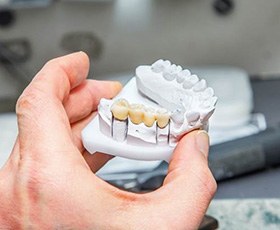
There are two different types of bridges that cater to different needs. Here is what each one consists of:
Traditional Dental Bridge
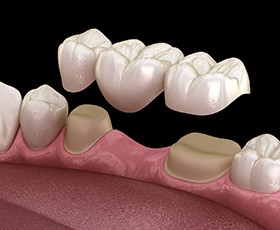
For patients who still have healthy teeth on either side of the gap, a traditional bridge is often the ideal option. The neighboring teeth that support the dental crowns are known as “abutment teeth,” and they will be altered slightly so the bridge fits comfortably in your mouth. This type of restoration can be placed in just a few visits to the dental office and is generally the most affordable type of bridge.
Implant Bridge
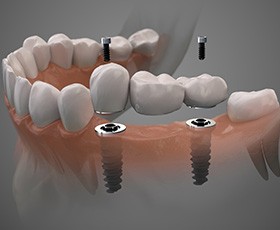
If you don’t have healthy adjacent teeth, surgically implanted metal posts called dental implants can provide an alternative. Dental implants can be used when there are three or more missing teeth in a row. Implant bridges last longer than traditional bridges on average, and they help to prevent bone loss over time due to tooth loss.
The Benefits of Getting a Dental Bridge

Dental bridges offer an alternative solution to more invasive, surgical procedures (i.e. dental implants) and can provide a multitude of benefits, including:
- Improvement of your oral health by keeping regular teeth in place and preventing shifting
- A more even distribution of your bite force
- A custom-made restoration that blends in seamlessly with the rest of your smile and is virtually undetectable to others
- The ability to enhance your aesthetic and boost your confidence
Dental Bridges FAQs
What Is the Dental Bridge Process?
If you’ve ever had a tooth prepared for a dental crown, you are already somewhat familiar with the process for a bridge. To make room for the prosthetic, your abutment teeth’s enamel needs to be reduced just a little. Then, we take an impression of your teeth using our digital system, which creates a model of your entire mouth. The lab uses this information to fabricate the custom bridge that will fit your mouth exactly. As a result, it should look and feel completely natural.
For an implant bridge, before we can create the restoration, we need to establish the posts in the jawbone. To accomplish this, we surgically insert the posts into strategic places in your jaw and allow new bone growth to surround these replacement roots. Once this process (called osseointegration) is complete, we can then begin the normal bridge procedure.
Does It Hurt to Get a Dental Bridge?
While we prepare your abutment teeth and remove enamel, you will be numb with a local anesthetic. As a result, you shouldn’t feel any pain while at our office. Even the impressions should be comfortable because we do not use traditional putty. Through our digital impression system, we can collect all the information we need without making you gag or causing you any unpleasantness.
After the anesthetic wears off, you may feel a little sensitivity in the abutment teeth with your temporary prosthetics on. However, your custom bridge should eliminate any discomfort. Overall, you shouldn’t experience full-blown pain getting a dental bridge.
How Many Teeth Can I Replace with a Dental Bridge?
With a traditional bridge, one that bonds to natural teeth, we typically can replace one or two teeth. Although we can substitute for three teeth, the restoration has less stability and strength with such a wide gap to cover. Implant bridges can compensate for three, up to as many as five, total missing teeth with just two posts. During your consultation, we can determine which option and the type of bridge that would best suit your smile and needs.
Am I a Good Candidate for a Dental Bridge?
For a traditional bridge, the only requirements are that you have a generally healthy mouth, that you have one strong tooth on each side of the gap, and that you are committed to keeping the bridge clean and in excellent condition moving forward.
If you are interested in an implant bridge, you must meet a few other qualifications. Most importantly, you need to have enough jawbone density to hold onto and stabilize your implants. Because implant bridges can take multiple months from start to finish, you also need to have the time and patience to undergo this treatment.